Showing 21-40 of 54 results
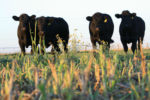
Cover Crops Incorporated into Rotational Grazing Improves Soil Health
BATON ROUGE, Louisiana – Over-seeding a diverse cool-season cover crop mix into a rotationally grazed warm-season grass pasture appears to improve soil health, especially when the system is managed over a longer period of time. In a limited study, funded by a Southern Sustainable Agriculture Research & Education (SSARE) Graduate Student Grant, Louisiana State University […]
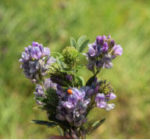
Integrating Legumes with Grass to Improve Forage-Livestock Systems
In a Southern SARE-funded Research and Education Grant (LS14-261), "Long-term Agroecosystems Research and Adoption in the Texas Southern High Plains -- Phase III," Texas Tech University researchers conducted a steer grazing trial comparing a grass only system to a grass-legume system for animal productivity and water use efficiency.
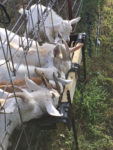
Searching for New Strategies to Control Gastrointestinal Parasites in Small Ruminants
PROSPECT, Tennessee – Jo Ann Harris calls out to a flock of Dorper sheep in a pasture: “Sheeep. C’mere sheep.” Almost immediately the animals come running to her side, head bumping her leg and begging for a head scratch before moving on to the food pellets Harris has laid out for them in containers. With […]
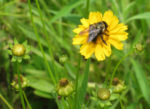
Artificial Nesting Sites Attract Native Pollinators
LAWRENCEVILLE, Georgia – Artificial nesting sites for pollinators placed in apple orchards have shown to boost native bee populations, according to results of a Georgia Gwinnett College study. In a Southern SARE-funded On-Farm Research Grant project, researchers focused on nesting sites for mason bees and mining bees – the workhorses of the native bee world […]
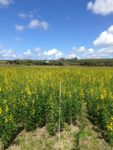
Get the Most Out of Forage Systems for Goats with Sunn Hemp
TUSKEGEE, Alabama – Small ruminant producers in the Southeast can potentially graze their goats year-round on a forage-based production system by incorporating a summer legume, such as sunn hemp, into the traditional bermudagrass pasture. Tuskegee University animal scientist Byeng-ryel Min found that a summer sunn hemp/bermudagrass forage mixture, or sunn hemp alone, followed by winter […]
Fewer Greenhouse Gases Released When Cattle Graze on Legume-rich Grass Pastures Compared to Nitrogen Fertilized Pastures
GAINESVILLE, Florida – Beef cattle that graze on legume-enriched grass pastures release fewer greenhouse gases compared with the typical nitrogen fertilization regimes in the Southeastern U.S., based on the limited results of a Southern Sustainable Agriculture Research & Education (SSARE)-funded study at University of Florida. The results offer a sustainable grazing management alternative for those […]
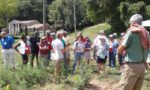
Getting a Glimpse of Sustainable Agriculture in Tennessee
NASHVILLE, Tennessee – Sustainable agriculture is growing in Tennessee and members of the Southern Sustainable Agriculture Research and Education (SSARE) program got a glimpse recently of the innovations, research, and marketing and productions methods driving that growth. Nearly 50 SSARE staff, members of the Administrative Council, and state ag coordinators were treated to a daylong […]
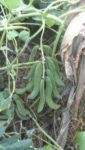
Bringing Velvet Bean Back as a Grazing Forage
MANOR, Georgia – Motorists passing through rural Manor, GA along Highway 122, perhaps on their way to Waycross, were puzzled by the mystery crop growing on a portion of Lynn Barber’s Heritage Acres farm. “Some of the older farmers knew exactly what it was, but a lot of people were stopping to ask me if […]
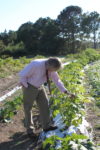
Compost Made with Freshwater Fish Improves Vegetable Yields Based on South Carolina Farmer Study
JOHNS ISLAND, South Carolina – Compost made from freshwater fish appears to perform just as well as compost made from saltwater fish in vegetable production, based on the results of a Southern Sustainable Agriculture Research & Education (SSARE) farmer project. The results point to increased opportunities of using freshwater fish waste as compost in areas […]
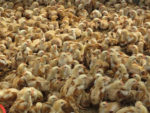
Artificial Light Sources in Chicken Houses Increase Egg Laying in Hens During Fall and Winter
COMMERCE, Texas – Research at Texas A&M University-Commerce has found that adding a safe, artificial light source to the coops of pasture-raised poultry increases egg laying in hens in the fall and winter – a time of the year when egg production in pasture poultry generally declines. Graduate student Margaret Morgan said that the main […]
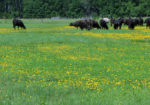
Integrating Perennial Peanut into Grass Pastures
GAINESVILLE, Florida -- Rhizoma peanut (commonly known as perennial peanut) is a warm-season perennial legume well adapted to Florida. It has high digestibility (65-75%) and crude protein concentrations (15-20%), that can really boost livestock performance. Integrating rhizoma peanut into bahiagrass pastures can almost double livestock performance, compared to bahiagrass alone (Figure 1). Rhizoma peanut also […]
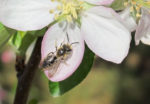
Artificial Nest Sites Boost Native Bees in Apple Orchards
LAWRENCEVILLE, Georgia – Researchers with Georgia Gwinnett College have found that creating artificial nesting sites for native bees helps to increase their abundance – a boon for producers looking to native bee species to pollinate their crops. For several years, zoologist and project coordinator Mark Schlueter and taxonomist Nick Stewart, have been surveying native bees […]
Arkansas Study Finding Ways to Integrate Poultry with Pasture Species and Agroforestry Production
FAYETTEVILLE, Arkansas – With the right tools for alternative feeding systems and pasture enrichment, farmers can successfully incorporate poultry into free-range, multi-species pasture or agroforestry production, based on the results of a USDA-ARS Arkansas study. The Southern Sustainable Agriculture Research & Education (SSARE)-funded project (LS10-226), “Integrating Free Range Poultry with Ruminant and Agroforestry Production in […]
Economic Analysis of Commercial Aquaponic Production Systems
Three case studies of aquaponic production systems in Texas, Florida and the U.S. Virgin Islands that show commercial aquaponics systems can be economically viable options for producers.
Soil Quality of Integrated Crop/Livestock Systems: Enhancing soil carbon sequestration and microbial diversity
In the Southern SARE-funded study (LS10-229), “Integrated Crop and Livestock Systems for Enhanced Soil Carbon Sequestration and Microbial Diversity in the Semi-arid Texas High Plains,” Texas Tech University researchers evaluated integrated crop/livestock systems for long-term soil quality by assessing microbial activity and soil carbon storage.
Agroecosystems Research in the Texas High Plains: Graduate student studies
Since 1997, over two dozen Master’s, PhD, and visiting students have conducted research and published articles related to sustainable integrated systems research in the Texas High Plains.The following are examples of current studies by Texas Tech University graduate students.
Diversifying in the Texas High Plains: Examples of agroecosystems models
The following system configurations are examples of the diversified crop/livestock production practices that have been studied across the Texas High Plains since 1997. These systems have been tested against cotton monoculture –a subsurface drip-irrigated system farmed with conventional cultural practices recommended for the High Plains region.
Sustainable Crop/Livestock Systems in the Texas High Plains: Phase III
In the Southern SARE-funded project (LS08-202), “Crop-Livestock Systems for Sustainable High Plains Agriculture,” the project continued into Phase III with system modifications and revisions to target greater water savings and profitability, and address emerging issues.
Sustainable High Plains Research Bulletins
A series of bulletins showcasing the various facets of Texas Tech University research on integrated crop and livestock production systems in the Texas High Plains. The bulletins cover sustainable agroecosystems, crops and soils, and water conservation.
Sustainable Crop/Livestock Systems in the Texas High Plains: Phase I
In a Southern SARE-funded project (LS97-082), “Sustainable Crop/Livestock Systems in the Texas High Plains”, Texas Tech University researchers hypothesized that viable grazing systems could be developed and that by integrating crops, forage, and livestock in production systems, their complementary benefits would allow a more sustainable use of water and soil while maintaining an appropriate level of crop and livestock production.