TIFTON, Georgia – Biochar, a soil amendment, mixed with poultry litter, an organic fertilizer, improved soil health and increased crop performance in south Georgia tomatoes, compared to biochar mixed with synthetic fertilizers, a University of Georgia study shows.
Funded through a Southern Sustainable Agriculture Research and Education (SSARE) Graduate Student Grant, horticulture professor Ted McAvoy and graduate student Emilio Suarez Romero studied how effective biochar was on soil health and crop productivity in combination with organic or inorganic fertilizers.
The study was initially conducted under the widespread hypothesis that biochar is a universally beneficial amendment for improving soil health and yield. However, researchers learned that it was not the biochar, but the poultry litter, that was the main driver of yield, while the biochar provided other benefits such as carbon sequestration, pH stability and crop quality.
“We moved from cautious optimism about biochar to a firm conviction that its economic viability is directly tied to its integration within a holistic, organic-based system,” the researchers noted in their project report. “We now understand that promoting sustainable agriculture isn’t about recommending a single product, but about helping growers build a resilient and profitable system.”
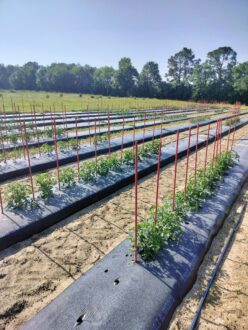
In the two-year study, researchers applied five rates of biochar (0,5,10,15, and 20 tons/acre), sourced from pine wood chips, as a one-time surface amendment prior to the first plasticulture tomato growing season. The target nitrogen rate application from both fertilizer sources was 225 pounds per acre. The synthetic fertilizer treatment involved a pre-plant application providing 50 pounds of nitrogen per acre with the remaining 175 pounds applied evenly in 10 weekly fertigation events through a drip system. The full poultry litter rate was applied pre-plant in accordance with USDA guidelines for food safety.
To measure soil health, core samples were collected throughout the growing season – biweekly for nitrogen analysis and every 30 days for other chemical and biological inputs. Samples were analyzed for properties including soil pH, organic matter content, active carbon, and microbial activity.
At the end of the two-year study, researchers found improved soil health with the biochar/poultry mix compared to the biochar/synthetic fertilizer mix. Benefits included a 34 percent higher cation exchange capacity, as a measure of higher soil fertility, with poultry litter compared to the synthetic fertilizer; higher microbial activity; a 5.6 percent increase in active carbon, whereas under the synthetic fertilizer active carbon decreased 5.2 percent over the same period; and a 4.5 percent increase in organic matter compared to a decline with the conventional fertilizer.
Additionally, the biochar-poultry litter mix was more effective at holding nitrogen in the root zone. In treatments with poultry litter, total inorganic nitrogen achieved a 144 percent gain at the highest biochar rate application.
To measure crop performance during the study, the researchers measured plant growth, crop yield and crop quality. Over the two-year study, researchers observed more vigorous plant growth with the biochar-poultry litter mix, compared to the biochar-conventional fertilizer mix. On average plants were 32 percent taller and had 27 percent larger stem diameters. Additionally, plants in the conventional fertilizer plots had a 67 percent higher mortality rate.
One notable direct impact from biochar was on fruit quality. Higher biochar rates reduced the physiological disorder “zippering” by up to 47 percent. Zippering is a cosmetic flaw in the fruit characterized by longitudinal scars. The disorder affects the fruit’s appearance but is still edible.
The project outcomes provided critical insights into the short-term benefits of integrating biochar and poultry litter in plasticulture tomato production.