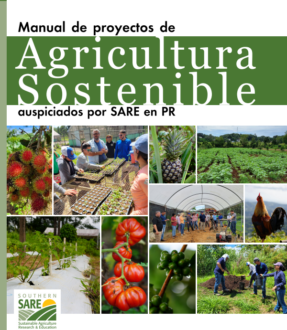
The manual establishes as its conceptual foundation that sustainable agriculture seeks to meet current needs without compromising future generations, integrating three fundamental pillars: long-term profitability, conservation of natural resources, and the well-being of agricultural communities.
Throughout the document, multiple projects developed between 1999 and 2025 are presented, organized into key areas such as:
- Climate resilience, through adaptive practices and integrated pest management.
- Soil health, including the use of cover crops, compost, biostimulants, and precision agriculture.
- Sustainable livestock production, focused on animal welfare and production efficiency.
- Biodiversity and agroforestry, promoting integrated systems and resource conservation.
- Community vitality, through urban agriculture and collaborative networks.
- Farmer health and well-being, recognizing the human factor as a central component of the agricultural system.
- Education and outreach, through workshops, field days, educational materials, and continuous training.
The manual also demonstrates the impact of the SARE program in Puerto Rico by strengthening farmers’ capacities, promoting the adoption of sustainable practices, and generating applied knowledge adapted to tropical conditions. It also highlights the importance of non-formal education and knowledge transfer as key tools for the adoption of innovations.
Overall, the document serves as an outreach, training, and technical reference tool that facilitates the replication of sustainable practices and contributes to the development of a more resilient, productive, and sustainable agricultural system in Puerto Rico.
URL: https://www.uprm.edu/sea/manualagrisos/
Want more information? See the related SARE grant:
This material is based upon work that is supported by the National Institute of Food and Agriculture, U.S. Department of Agriculture through the Sustainable Agriculture Research and Education (SARE) program. Any opinions, findings, conclusions, or recommendations expressed in this publication are those of the author(s) and should not be construed to represent any official USDA or U.S. Government determination or policy.